

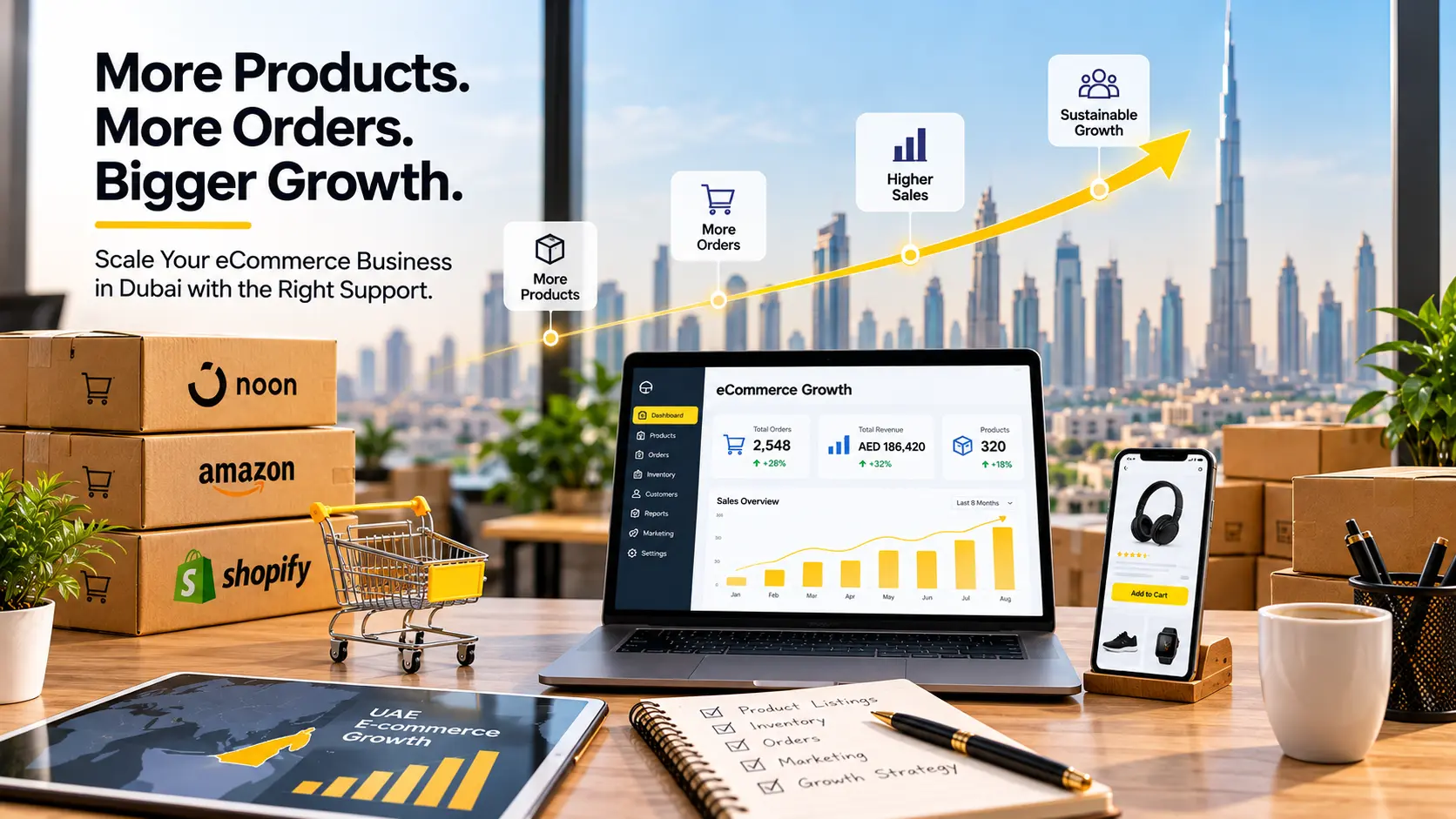
Your online store is getting more orders. You have added new products, started selling on marketplaces and reached customers you could not reach a year ago. It should feel like progress, but your team is spending more time fixing stock errors, updating listings and chasing orders than growing the business.
This is a common challenge for businesses moving beyond their early growth stage. The UAE’s eCommerce market reached AED 42.2 billion in 2025, up from AED 17.6 billion in 2020, according to a report by EZDubai and Euromonitor International. The market is projected to reach AED 67.2 billion by 2030. Source
For sellers, this growing market brings opportunity, but it also means managing more products, more orders and more customer expectations. An eCommerce growth agency Dubai businesses work with should look beyond sales figures and help address the processes that support long-term growth.
The real challenge is not simply getting bigger. It is building a business that can handle that growth without creating unnecessary work, errors or costs.
Why Does Growing an eCommerce Business Become Harder Over Time?
When a business starts selling online, its operations are often simple. The owner may manage product listings, check inventory, update prices and monitor orders personally. With a small catalogue, this arrangement can work well.
As sales increase, the workload changes.
A business selling 30 products on one platform has different needs from a business managing 300 products across its own website, Noon and other marketplaces. Each new product brings more information to maintain. Each sales channel adds another place to check stock, prices, orders and customer issues.
Growth can become difficult when the systems behind the business do not keep pace with sales.
Common warning signs include:
- Product listings showing different information across marketplaces.
- Stock records that do not match actual inventory.
- Orders take longer to process during busy periods.
- Team members repeating the same manual tasks every day.
- Sales are increasing without a clear understanding of profit.
- Customer complaints are becoming harder to resolve.
These issues do not always mean a business needs more employees. Sometimes, the existing process needs to be organised better.
1. More Products Should Not Mean More Listing Errors
Adding new products gives customers more choice, but every product also needs accurate information, clear images, correct pricing and the right category details.
Problems often appear when product information is copied manually between platforms. A specification gets missed, an old price remains active or a product variant is assigned incorrectly. These small mistakes can create confusion for customers and additional work for the seller.
A better approach starts with a central product information process. Maintain approved details for each product and adapt them to the requirements of each marketplace.
Before publishing or updating a listing, check:
- Product name and description.
- Images and specifications.
- Sizes, colours and other variants.
- Price and stock availability.
- Category and required attributes.
As the catalogue grows, eCommerce marketplace management services can help businesses maintain listings, organise product data and coordinate updates across their selling channels.
The aim is to make catalogue expansion easier without allowing the quality of existing listings to decline.
2. Selling on Noon Requires More Than Uploading Products
For many businesses in the UAE, Noon can provide another route to customers. However, expanding onto the platform adds its own listing requirements, account tasks and operational responsibilities.
Sellers need to maintain accurate product information, monitor stock, review account notifications and keep track of orders and returns. These responsibilities become harder to manage when the same team is already handling a website and other marketplaces.
Noon eCommerce services can cover different types of support, depending on the provider. These may include catalogue maintenance, product listing updates, account assistance and operational coordination.
Before expanding, sellers should decide who will manage these tasks and how the work will fit into existing operations. They should also check the latest platform requirements and confirm which responsibilities remain with the seller.
The goal is to make Noon an organised part of the business rather than another channel that creates avoidable administrative work.
3. Higher Sales Do Not Always Mean Higher Profits
Revenue is an important measure, but it does not show the full picture.
A business may generate more orders after running discounts or spending more on advertising. Yet marketplace fees, delivery costs, returns and promotional expenses can reduce the money left from each sale.
For this reason, growing sellers should review profitability alongside sales volume.
Consider a product that sells well during a promotion. Before repeating the offer, calculate the product cost, marketplace fees, fulfilment expenses and discount. The result can help you decide whether the promotion is worth running again.
Useful measures to review include:
- Revenue and order volume by channel.
- Profit margins by product.
- Returns and cancellations.
- Advertising costs, where applicable.
- Stock holding and slow-moving products.
A clear view of these numbers helps businesses put more attention on products and channels that support sustainable growth.
4. Your Team Should Not Spend the Entire Day on Repetitive Tasks
When a business grows, team members can become occupied with routine work: copying product information, checking stock levels, responding to recurring questions and following up on pending orders.
Some of these tasks are necessary, but not all of them need to be handled manually.
Look at the activities your team repeats each week. Identify which ones could be standardised, supported by software or assigned through a clearer workflow.
For example, a standard listing checklist can reduce repeated corrections. A shared task tracker can make outstanding issues easier to follow. Suitable integrations may help reduce manual stock updates.
For tasks that still require regular attention, eCommerce seller support services can provide additional operational assistance, depending on the scope of the service. This can free internal teams to focus on product selection, customer relationships, business planning and other work that supports growth.
5. When Should You Work With an eCommerce Growth Agency?
Not every online seller needs external support immediately. A small business with a manageable catalogue may be able to handle its operations internally.
Support becomes worth considering when growth starts exposing gaps in the way the business works.
You may need help if:
- Your catalogue has grown beyond what your team can maintain easily.
- You are selling across several marketplaces.
- Inventory and order issues keep recurring.
- Product updates take too much time.
- You cannot clearly compare performance across channels.
- Your team is struggling to manage daily operations alongside expansion plans.
An eCommerce growth agency Dubai, like Creative Circuit can help in this regard, Thus, businesses should understand the difference between increasing sales and building the processes needed to support those sales.
Ask what the agency actually handles, how responsibilities are divided and how progress will be measured. Some providers focus on marketing and customer acquisition, while others offer marketplace operations or broader growth support. Confirm that the services match your business needs rather than assuming every agency covers everything.